From burning ad spend to a system that compounds
ROAS went from 2.4x to 6.7x on the same ad budget. Not from better creative or a bigger spend, but from fixing what was broken underneath the ads: the data, the catalog, the funnel and the retention layer.
Proof
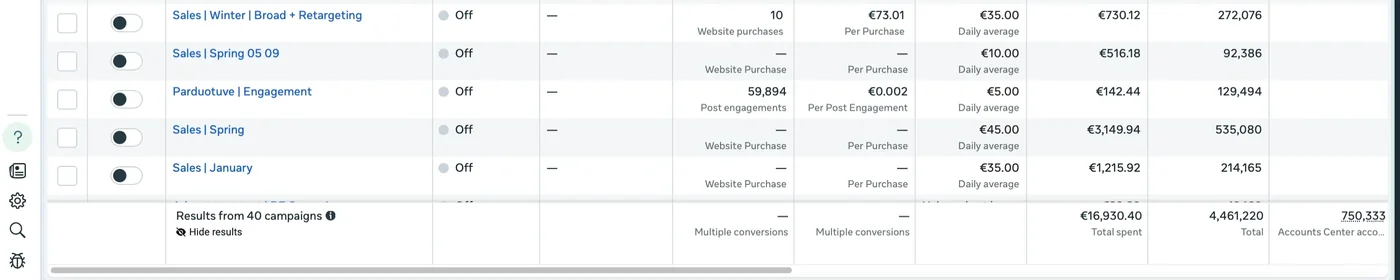
Starting state
- ROAS sitting at roughly 2.4x–3x, running reach and engagement campaigns on an e-commerce account
- Product catalog broken due to a faulty data feed sync
- Out-of-stock products still actively being advertised
- Seasonal mismatches — winter collection promoted in summer
- Tracking events not set up correctly, and no Conversion API in place
- Ads running with no clear optimization logic; add-to-cart cost as high as €140+ in places
- Conversion rate under 0.8%, and no email marketing at all
What was changed
- Rebuilt the data foundation: GA4, event tracking, and Conversion API
- Fixed the product catalog and put a stock-management process in place
- Redesigned the website and funnel, adding upsell and cross-sell blocks
- Restructured campaigns around CPA-based optimization with clear funnel logic
- Fully utilised warm retargeting audiences and cut spend on dead-weight placements
- Built a retention channel from scratch: pop-up email capture, abandoned-cart and welcome automations, and a running campaign calendar
6 months later: the system kept compounding
- Expanded beyond single-channel dependency — added Google Ads and a short-form video channel (TikTok Ads) alongside the original Meta-only setup
- Cut cost per acquisition roughly in half (~€60 → ~€30)
- Built out the retention layer further — automated email/SMS flows now running continuously, not just the original abandoned-cart sequence
- 95%+ of orders now traceable to a specific channel — real attribution across the account, not single-channel guesswork
What this account actually teaches
Every decision here — tracking, catalog, funnel, retention, and the channel expansion that followed — was made by Juliana Vedricka as the single owner of the account, not routed through separate agencies per channel.
Most e-commerce accounts lose money not because of the ads, but because of what is broken underneath them. Fix the data, the funnel and the offer first. Ad spend alone just burns budget on top of an unfixed system.
Delivered as a growth partner engagement: acquisition, funnel and retention owned as one system rather than briefed out to three suppliers.
Frequently asked questions
Why did ROAS improve without increasing ad spend?
Because the ad spend was never the actual problem. No one owned unit economics across the funnel — acquisition, conversion and retention were each left unmanaged, on top of broken tracking, an expired catalog and no retention layer. There was no strategy or plan running underneath any of it. Fixing every stage first, then building a growth system around a marketing calendar for launches, offers and ongoing metric optimization, let the same budget convert at a much higher rate.
How long does it take to fix a broken e-commerce ad account?
The technical rebuild — data foundation, catalog and tracking — is usually the fastest part and takes a few weeks. Taking ownership of the full funnel, acquisition through retention, with a real strategy and marketing calendar behind it, is what compounds over months, as this account shows six months in.
Is it better to fix one weak stage or the whole funnel at once?
The whole funnel. Fixing tracking alone, or CRO alone, or retention alone, just moves the leak somewhere else. Acquisition, conversion and retention have to be owned as one system, with real unit economics behind every stage, before spend decisions mean anything.
Does adding more ad channels actually lower cost per acquisition?
It can, when each channel is added inside a system that's already tracking unit economics properly, not bolted onto a leaking funnel. In this account, adding Google Ads and a short-form video channel alongside Meta cut blended cost per acquisition roughly in half within six months.